
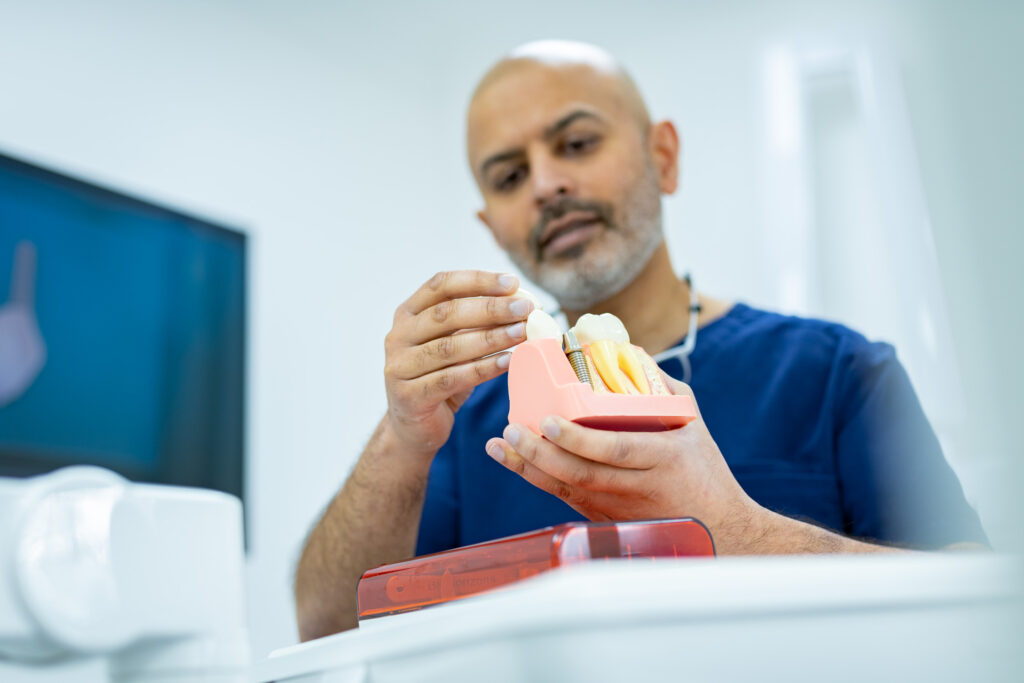
Every dentist will tell you that saving a natural tooth is always the goal.
I used to say the same thing. I don’t anymore.
After 25 years in dentistry, with an MSc in Clinical Periodontology and a career focused on the gum and bone that decide whether a tooth has a future, I’ve changed how I think about this question. Not because I’ve stopped caring about saving teeth, but because I’ve seen what happens when we save the wrong ones for too long.
Here’s what I’ve learned, and how I actually make the call.
Why saving a tooth is usually the right first instinct
A healthy natural tooth is still the gold standard. Nothing we place artificially quite matches the way a real tooth root sits in your jawbone, keeps that bone healthy, and works within a bite that has settled over many years. If a tooth can be saved well, and kept stable for the long term, saving it is the right choice.
The key words there are “well” and “long term”.
Often that means root canal treatment followed by a crown, and when the tooth is a good candidate it can serve you for many years. My colleague Dr Aman Phull explains what that involves in Is a Root Canal Really as Bad as Everyone Says?
Where the save-everything instinct goes wrong
The problem is that the instinct to save a tooth can sometimes work against a patient’s best interests. I’ve seen patients who have invested in crown after crown and root canal after root canal, each step reasonable on its own, only to end up with a tooth that fails anyway, and a jaw that has lost a lot of bone along the way.
Bone loss is the quiet consequence that doesn’t get talked about enough. When a failing tooth is kept for years, the bone around it can carry on breaking down. That bone matters, both for the shape of your face and for any implant you might need later. A tooth taken out at the right time and replaced promptly often leaves far more bone to work with than the same tooth taken out two years later, after repeated attempts to save it.
The questions I actually ask
When I’m deciding whether a tooth is worth saving, I look at a few things in particular:
- How much healthy bone is still holding the root? If less than half of the root is still supported by bone, the long-term outlook changes significantly, whatever we do above the gum.
- Can the problem actually be repaired? A crack that runs down below the level of the bone can’t be fixed, however good the crown on top.
- What’s the realistic ten-year outcome? Not the best case. The realistic one.
- What does the patient want, and what are they able to keep up? A tooth that needs intensive ongoing care just to survive isn’t a good outcome for someone who finds regular visits difficult.
When removing and replacing is the kinder option
I’ve had patients sit in front of me who have spent thousands trying to save a tooth that, clinically, was already lost. The kindest thing I can do then isn’t another heroic attempt at a repair. It’s to be honest, explain clearly what the bone is telling us, and help them plan a proper replacement.
Modern implant dentistry, done well, gives you a fixed, natural-looking tooth that, for most people, feels and works very much like their own. Planned properly and placed at the right time, an implant isn’t a consolation prize. For the right patient, it’s a better long-term outcome than continuing to fight for a tooth that’s running out of road. You can see two real cases I’ve talked through on our dental implants page.
What it costs
Cost matters in this decision, so here are our figures. Root canal treatment is £935, and a crown to protect the tooth afterwards is £940. A single dental implant, including the crown, starts from £2,500. If a tooth has a good long-term outlook, saving it is usually the better-value choice. If it doesn’t, money spent trying to keep it can end up as money you’d have been better putting towards a replacement. Our full prices are on the fees page.
My honest position
Save a tooth whenever it can genuinely be saved well, with a realistic long-term outlook, at a cost that makes sense for the patient. But never save a tooth just because saving teeth is what dentists are supposed to do.
Some of the best decisions I’ve made in 25 years haven’t involved keeping everything. Sometimes the most skilled clinical decision is recognising when to stop.
If you’re facing this decision yourself, or you’ve been going back and forth with a tooth that never quite settles, our implant consultations are free. Come in, bring any X-rays you have, and we’ll look at what the bone is actually telling us.
No pressure. Just an honest conversation.
Quick answers from Dr Naresh
More on saving or removing a tooth
Dr Naresh Hirani is the Principal Dentist at Chalfont Dentist & Implant Centre in Chalfont St Peter. He qualified from Guy’s, King’s and St Thomas’ in 2001, holds an MSc in Clinical Periodontology and has been placing and restoring dental implants since 2007.