
A few weeks ago I was dropping my son Raul off at school when another parent caught me at the gate. She knew I was a dentist and, a little sheepishly, asked: “Can I ask you something? My dentist says I need a root canal. Is it really as bad as everyone says?”
Raul had already vanished into the playground, so we had a few minutes. I gave her the short version there and then. This is the longer version, because it’s probably the question I’m asked most, at the school gate or anywhere else.
The short answer
No. For most people, having a root canal feels much like having a large filling. You’re numb, you lie back, and the hardest part is usually keeping your mouth open for a while. The pain people link with root canals nearly always comes from the infected tooth beforehand, not from the treatment that sorts it out.
What a root canal actually is
Inside every tooth is a space containing the pulp, the soft tissue with the nerve and blood supply. If decay, a crack or an old deep filling lets bacteria in, the pulp can become inflamed or infected. That’s when you get the throbbing toothache that keeps you awake, sensitivity to hot drinks that lingers, or a little gum boil that comes and goes.
Root canal treatment removes the damaged pulp, cleans and disinfects the tiny canals inside the roots, and seals them so bacteria can’t get back in. The tooth stays where it is and carries on doing its job.
The myths I hear most
“It’s going to really hurt”
With modern local anaesthetic, the treatment itself shouldn’t hurt. A very inflamed tooth can be harder to numb, so I take my time and make sure it’s properly numb before I start, topping up if needed. Afterwards it’s normal for the tooth to feel tender for a few days, and over-the-counter painkillers usually deal with that.
“It takes forever”
Most root canals are done in one or two appointments. Back teeth have more canals and more complicated shapes than front teeth, so they take longer, and an appointment can last up to an hour and a half. Plenty of my patients bring headphones and listen to a podcast.
“I might as well just have it out”
Sometimes taking a tooth out is the right call, and if I don’t think a tooth can be saved, I’ll tell you. But removing a tooth isn’t the end of the story. The gap often needs a bridge or a dental implant, which means more treatment and more cost. If a tooth can be saved predictably, keeping it is usually the better long-term option.
“It doesn’t hurt, so it can’t need treatment”
Some infected teeth are completely painless. We spot them on an X-ray, or because a small gum boil keeps reappearing. An infection at the tip of the root can slowly damage the bone around it, so “it doesn’t hurt” isn’t a good reason to leave it.
How I carry out root canal treatment
I’ve trained specifically in this area, with a Postgraduate Diploma in Endodontics from the University of Chester, and root canal treatment is a big part of my working week at Chalfont Dentist. A few things make a real difference to the result:
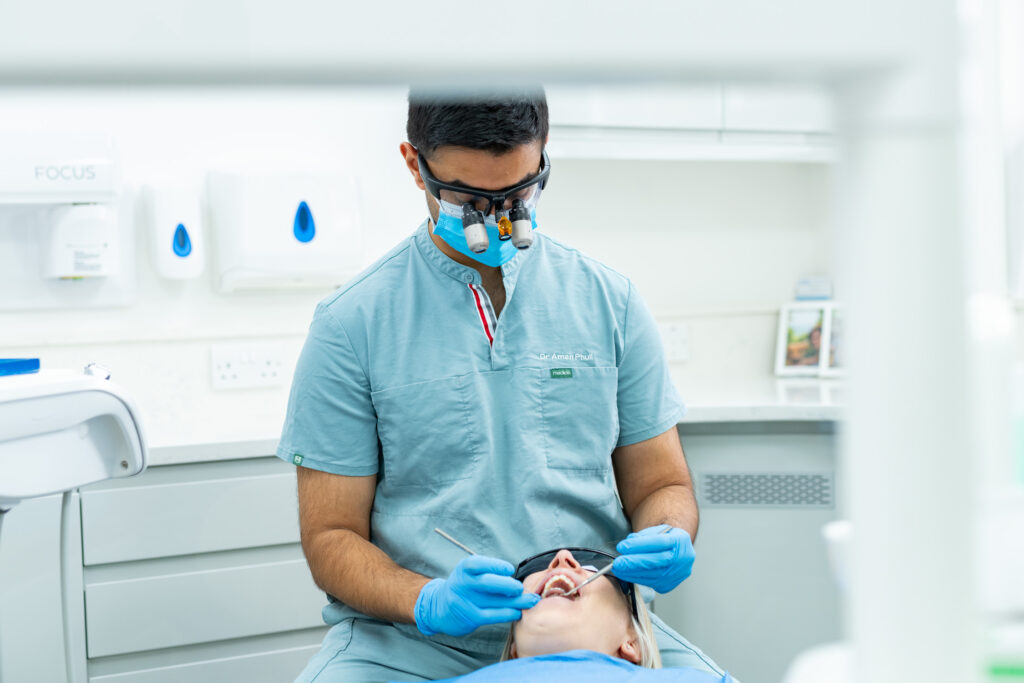
- A dental microscope. The canals inside a tooth can be finer than a hair. Working under high magnification lets me find and clean canals that are easy to miss with the naked eye.
- A rubber dam. This thin sheet isolates the tooth, keeps saliva and bacteria out, and stops cleaning solutions going anywhere they shouldn’t. Most people find it more comfortable than cotton rolls stuffed in their cheek.
- 3D scans when needed. For complicated teeth we can take a CBCT scan here at the practice, so I can see the shape of the roots and any infection in three dimensions before I start.
I also help teach root canal techniques to other dentists, which keeps me honest about doing things properly.
What happens afterwards
A back tooth that has had a root canal is often weaker, because decay and the treatment itself remove some of its structure. In most cases I’ll recommend a crown or onlay to protect it from cracking, and we can often make these here at the practice. Front teeth usually just need a good filling.
After that, treat it like any other tooth: brush twice a day, clean between your teeth and keep up your check-ups. A well-treated, well-restored tooth can last for many years.
What it costs
Root canal treatment at our practice costs £935, and re-treating a tooth that has had a root canal before costs £950. A crown or onlay to protect the tooth afterwards is £940. You can see everything on our fees page, and we offer 0% finance over 3 to 12 months through Tabeo (subject to a credit check).
If you’re nervous
If the thought of it is too much, tell us. We’ll go at your pace, explain each step before we do it, and stop whenever you need a break. For very anxious patients we can talk about whether IV sedation would help.
So, to the parent at the school gate: no, it isn’t as bad as everyone says. And if you’ve been told you need a root canal, or you’ve got a tooth that keeps grumbling, come and see us. You can also read more about root canal treatment at Chalfont Dentist.
Dr Aman Phull is an Associate Dentist at Chalfont Dentist & Implant Centre in Chalfont St Peter, with a special interest in root canal treatment. He holds a Postgraduate Diploma in Endodontics from the University of Chester and an MSc in Aesthetic and Restorative Dentistry from King’s College London, and is a member of the British Endodontic Society.