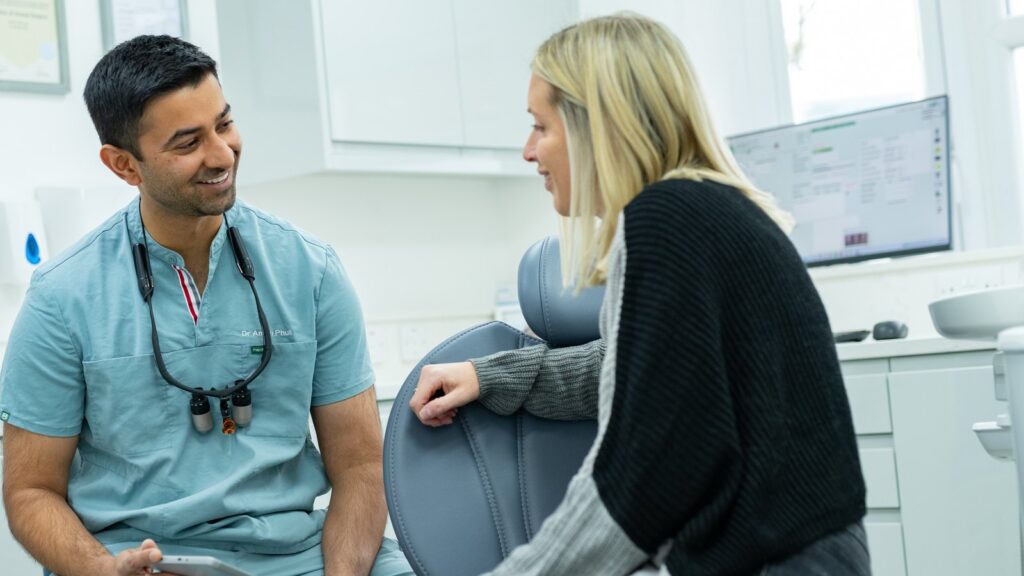
If you’ve put off seeing a dentist for years because the thought of it makes your stomach turn, you are far from alone. Dental anxiety is one of the most common fears there is, and plenty of the people who sit in my chair have felt exactly the same. Some were let down by a dentist in the past. Some can’t tell you where it started. Some are fine right up until they smell the surgery.
I’m not going to tell you to “just relax”. It doesn’t work, and if it did you’d have done it already. What I can do is tell you how we do things here, so you know what to expect before you walk through the door.
You’re in charge of the pace
The most important thing we can give a nervous patient is control. Before we start anything, we agree a stop signal, usually raising your hand. When you use it, we stop. No negotiating, no “just one more second”.
We’ll explain what we’re about to do before we do it, and we won’t spring surprises on you. If you’d rather not hear the details, tell us that too. Some people want a running commentary and some want to think about their holiday. Both are fine.
Your first visit can just be a conversation
You don’t have to have any treatment at your first appointment. If it helps, come in, meet us, sit in the chair if you feel like it, and go home. A lot of people find the dread is worse than the visit, and once they’ve seen the room and met the team, the fear shrinks to something they can manage.
Tell us when you book that you’re anxious. Our reception team will make a note, we’ll try not to keep you waiting, and we can book a longer appointment so nothing feels rushed.
Small things that make a big difference
- Book the first appointment of the morning, so you aren’t spending all day dreading it.
- Bring headphones and your own music or a podcast.
- Eat normally beforehand unless we’ve told you otherwise. Low blood sugar makes anxiety worse.
- Bring someone with you if that helps. They’re welcome to sit in.
- Ask for breaks. Your jaw gets tired, and so do your nerves.
Numbing that actually works
A lot of dental fear goes back to a painful injection, or a tooth that wasn’t properly numb. We put a numbing gel on first, give the anaesthetic slowly, and wait until it has fully taken effect before we start. If you can still feel something, say so. That isn’t you being difficult. It just means we need to give a little more.
IV sedation when you need more help
For some people, gentle care and good conversation aren’t enough, and that’s nothing to be embarrassed about. IV sedation means a small cannula in the back of your hand or arm, through which we give a sedative medicine. You stay awake and can respond to us, but you feel deeply relaxed, time seems to pass quickly, and most people remember very little of the appointment afterwards.
I’m trained to provide sedation, as is our dental nurse Corinne Collier. For our most anxious patients we also work with Dr Etienne Deysel, a sedationist with more than 20 years of experience. We monitor your breathing, oxygen levels and pulse throughout.
Sedation is particularly useful for longer treatment such as dental implants or wisdom tooth removal, and for anyone who simply can’t face treatment any other way. It costs £429 per appointment.
There are some rules to follow. You’ll need a responsible adult to take you home and stay with you afterwards, and for the next 24 hours you mustn’t drive, drink alcohol, use machinery or sign anything important. Before we book you in, we’ll go through your medical history and medicines to make sure sedation is safe for you, and we’ll give you written instructions to take home.
Dental Phobia Certified
I’m a Dental Phobia Certified dentist, which you can check on the Dental Phobia Certified website. It isn’t a magic badge, but it does mean I’ve committed to an approach built around listening and patience rather than working through a list as fast as possible.
Why it’s worth taking the first step
Dental problems rarely stay small. Left alone, a tooth that needed a filling can end up needing a root canal, and a loose tooth can end up needing to come out. The kindest thing you can do for your future self is come in while things are still simple.
If you’re reading this with your heart beating a little faster than usual, that’s okay. Call us on 01753 888 000 and tell us you’re nervous, or send us a message if picking up the phone is part of the problem. We’ll take it from there, at your pace.
Quick answers from Dr Naresh
A word on dental anxiety
Dr Naresh Hirani, Principal Dentist at Chalfont Dentist & Implant Centre, Chalfont St Peter, and a Dental Phobia Certified dentist.