
Most people who come to see me about an implant have already done some reading. They’ve seen a diagram of a titanium screw, a price that may or may not include the crown, and a timescale that seems to range from “same day” to “a year”. Then they sit down and ask the question that actually matters to them: what is going to happen to me, and when?
I’ve been placing and restoring implants since 2007, so I’ll answer that as plainly as I can. Every mouth is different and your plan will be your own, but the stages below apply to almost everyone.
Stage 1: The first conversation
Your first implant appointment with us is a consultation, and it’s complimentary. It isn’t a sales meeting. I want to understand what’s bothering you, whether that’s a gap you’re self-conscious about, a denture that moves when you eat, or a tooth that’s been on borrowed time for years.
I’ll examine your mouth and look closely at your gums. My MSc is in periodontology, and gum health is where implant success starts or ends. Then I’ll talk you through your options. Sometimes an implant isn’t the best answer. A bridge, a denture or keeping a tooth going a bit longer can be the right call, and if I think so, I’ll tell you.
Stage 2: The 3D scan and the plan
An ordinary X-ray is flat. To plan an implant properly I need to see the height, width and density of the bone, and exactly where the nerves and sinuses sit. We do this with a CBCT (3D) scan here at the practice, so there’s no trip to a hospital or imaging centre.
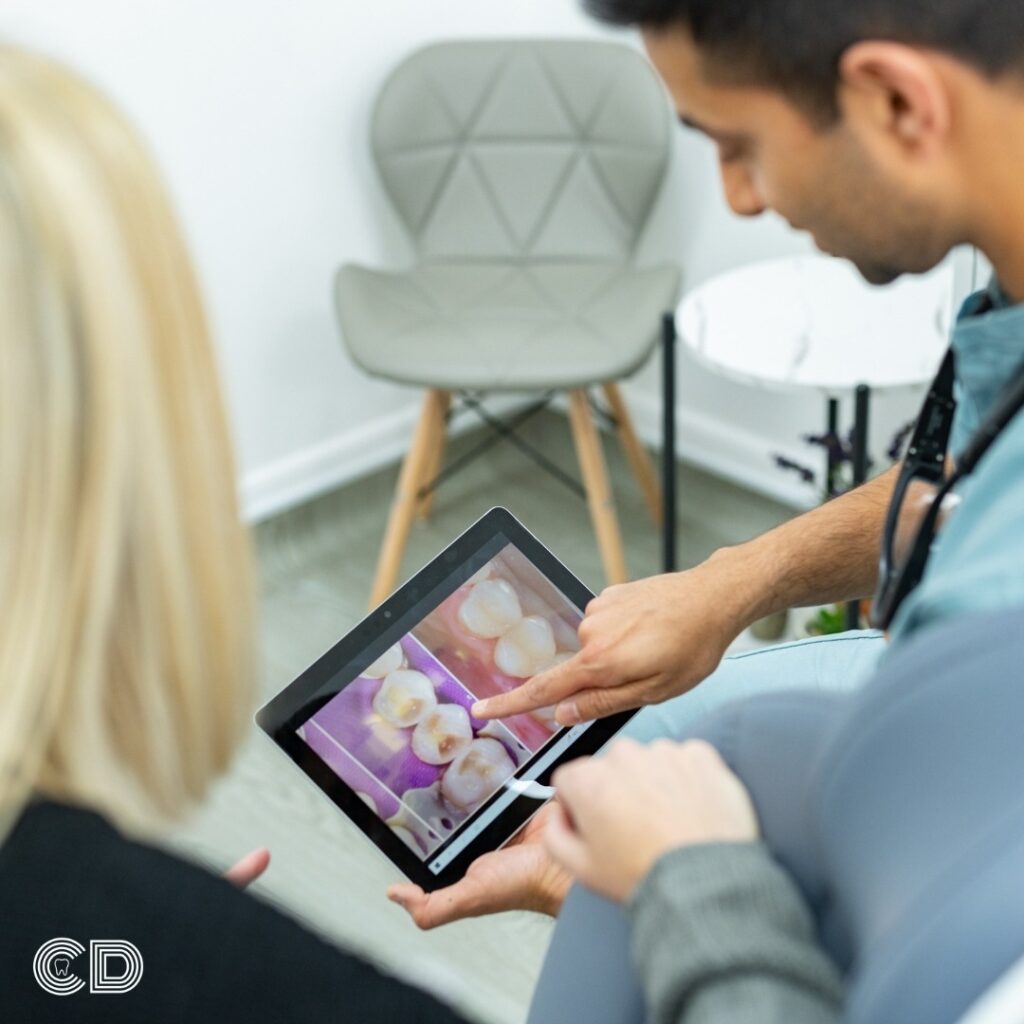
We’ll also take a digital scan of your teeth with our iTero scanner rather than the old trays of putty, which most people are relieved to hear. From the two scans I plan the implant’s position on screen before anything happens in your mouth. Where it helps, we use a surgical guide so that the plan on the computer is the plan in the chair.
You’ll then get a written treatment plan with the costs itemised. A single implant including the crown starts from £2,500, and bone grafting, if you need it, starts from £495. Our full price list is on the fees page, and if spreading the cost would help, we offer 0% finance over 3 to 12 months through Tabeo (subject to a credit check).
Watch: the implant mistake that happens before surgery even starts, and why planning matters so much.
Stage 3: Getting the foundations right
If a tooth needs to come out first, or your gums need treatment, we deal with that before anything else. Placing an implant in a mouth with active gum disease is a bit like building an extension on ground that’s still subsiding. It might look fine for a while.
Occasionally the implant can go in on the same day a tooth is removed. More often I’ll let the area heal for a couple of months first, or add a bone graft so there’s enough bone to hold the implant securely. I’ll explain which applies to you and why.
Stage 4: Placing the implant
This is the appointment most people worry about, and it’s usually much easier than they expect. It’s done under local anaesthetic, just like a filling, and a straightforward single implant typically takes about an hour. If you’re nervous, we can do it under IV sedation, so you’re deeply relaxed and often remember very little afterwards.
I use BioHorizons implants, a well-established system with long-term research behind it. Afterwards, most people tell me it was less uncomfortable than having a tooth out. Expect some tenderness and perhaps a little swelling for a few days. Over-the-counter painkillers are normally enough, and many people are back at work the next day.
If the implant is somewhere that shows when you smile, we’ll talk through a temporary tooth so you aren’t left with a gap while it heals.
Stage 5: Letting it heal
Now comes the patient bit. Over the next few months the bone grows onto the surface of the implant and locks it in place. This usually takes around three months, sometimes longer in the upper jaw or where we’ve grafted. Rushing it is the one thing I won’t do.
You’ll see us for a check or two during this time. Your job is to keep the area clean and avoid chewing anything hard on that side.
Stage 6: The final tooth
Once the implant has fused, we take another digital scan and design your crown to match your own teeth in shape and shade. Much of our crown work is milled here at the practice, which gives me tighter control over the fit and means you aren’t waiting weeks on a laboratory. The crown is then fixed in place, and for most people that’s the moment it stops feeling like “the implant” and starts feeling like their tooth.
Stage 7: Looking after it for the long term
An implant can’t decay, but the gum and bone around it can become inflamed, in much the same way as gum disease around a natural tooth. That is the main reason implants run into trouble years down the line, and it’s largely preventable.
- Clean around it as carefully as you clean your other teeth.
- Use interdental brushes every day, not just when you remember.
- Keep up your regular hygiene appointments.
- If you smoke, stopping is the single most helpful thing you can do for it.
Look after it and an implant is a long-term solution. Ignore it and it can run into the same problems as the tooth it replaced.
How long does the whole thing take?
For a single implant with no complications, plan on roughly three to six months from consultation to final tooth. If you need extractions, gum treatment or grafting first, it can take longer. I’d rather give you a realistic timescale at the start than an optimistic one that slips.
Can I have implants on the NHS?
Only in limited circumstances, and usually through a hospital: for example after treatment for mouth cancer, a serious facial injury, or where teeth never developed. For most adults, implants are private treatment. If you think you might qualify, ask your GP or NHS dentist about a referral. I’m also happy to talk it through with you.
If you’re thinking about it
Write down the questions you want answered and bring any old X-rays you have. Then book a consultation. You’ll leave knowing whether implants are right for you, what they would cost and how long it would take, with no obligation to go ahead.
Quick answers from Dr Naresh
Planning, explained in a minute
Dr Naresh Hirani, Principal Dentist at Chalfont Dentist & Implant Centre, Chalfont St Peter. Naresh qualified from Guy’s, King’s and St Thomas’ in 2001, holds an MSc in Clinical Periodontology and has been placing and restoring dental implants since 2007.